
The Rise of the Home Wine Cellar
Over the last decade, custom wine cellars have moved from the domain of collectors and estates to a feature that homeowners throughout Cincinnati, Mason, Indian Hill, and the greater Southwest Ohio region are incorporating into their homes. Whether it is a small closet conversion holding 100 bottles or a full basement cellar housing a serious collection, a wine cellar adds both lifestyle value and real estate appeal.
At Miami Woodworking, we have designed and built wine cellars of every size and style over our nearly 30-year history. This guide draws on that experience to walk you through the key decisions involved in creating a wine cellar that is as beautiful as it is functional.
Step 1: Finding the Right Space
The first decision is where to put your cellar. The ideal location shares several characteristics:
Consistent Temperature. Wine stores best at 55-58 degrees Fahrenheit with minimal fluctuation. Basements naturally maintain more stable temperatures than above-ground rooms, making them the most common choice.
Minimal Light Exposure. UV light degrades wine over time. Interior rooms, basements, and closets without windows are ideal. If your chosen space has windows, they should be blocked or replaced with insulated panels.
Reasonable Humidity. Ideal humidity for wine storage is 60-70%. Too dry and corks shrink, allowing air into the bottle. Too humid and mold can develop on labels and racking. Ohio’s natural humidity levels are moderate, but a properly designed cellar includes humidity management.
Accessibility. Your cellar should be convenient enough that you actually use it. A basement location near your entertainment area or a closet conversion near the kitchen keeps wine accessible for everyday enjoyment.
Common Spaces We Convert
In our experience serving homeowners throughout Cincinnati and Southwest Ohio, the most common cellar locations include:
- Basement rooms — Dedicated rooms in finished or unfinished basements, often near a bar or entertainment area
- Under-stair spaces — The triangular space beneath a staircase can hold 200-400 bottles with clever racking design
- Walk-in closets — Converting a spare closet provides a compact, insulated cellar close to living areas
- Dedicated pantry spaces — Butler’s pantries and kitchen-adjacent rooms make excellent small cellars
Step 2: Climate Control
Wine cellar climate control is a specialized discipline. A standard HVAC system cannot maintain the precise temperature and humidity conditions that wine requires. Purpose-built wine cooling systems are essential for any cellar that will hold wine long-term.
At Miami Woodworking, we focus on the woodwork — the racking, cabinetry, doors, and architectural details. For climate control, we work with trusted HVAC partners who specialize in wine cellar installations. This collaborative approach ensures that the cooling system is properly integrated with our woodwork design.
Key climate considerations include:
- Cooling capacity — The unit must be sized for the room’s cubic footage, insulation level, and target bottle count
- Insulation — Cellar walls, ceiling, and floor require proper insulation and vapor barriers to maintain conditions
- Vapor barriers — Essential to prevent moisture migration, which can damage both the wine and the woodwork
- Door sealing — The cellar door must provide an airtight seal. We build custom wood doors with proper weather stripping and insulated cores
Step 3: Designing the Racking Layout
This is where our expertise truly shines. A well-designed racking system maximizes bottle capacity while creating a cellar that is organized, accessible, and visually stunning.
Racking Configurations
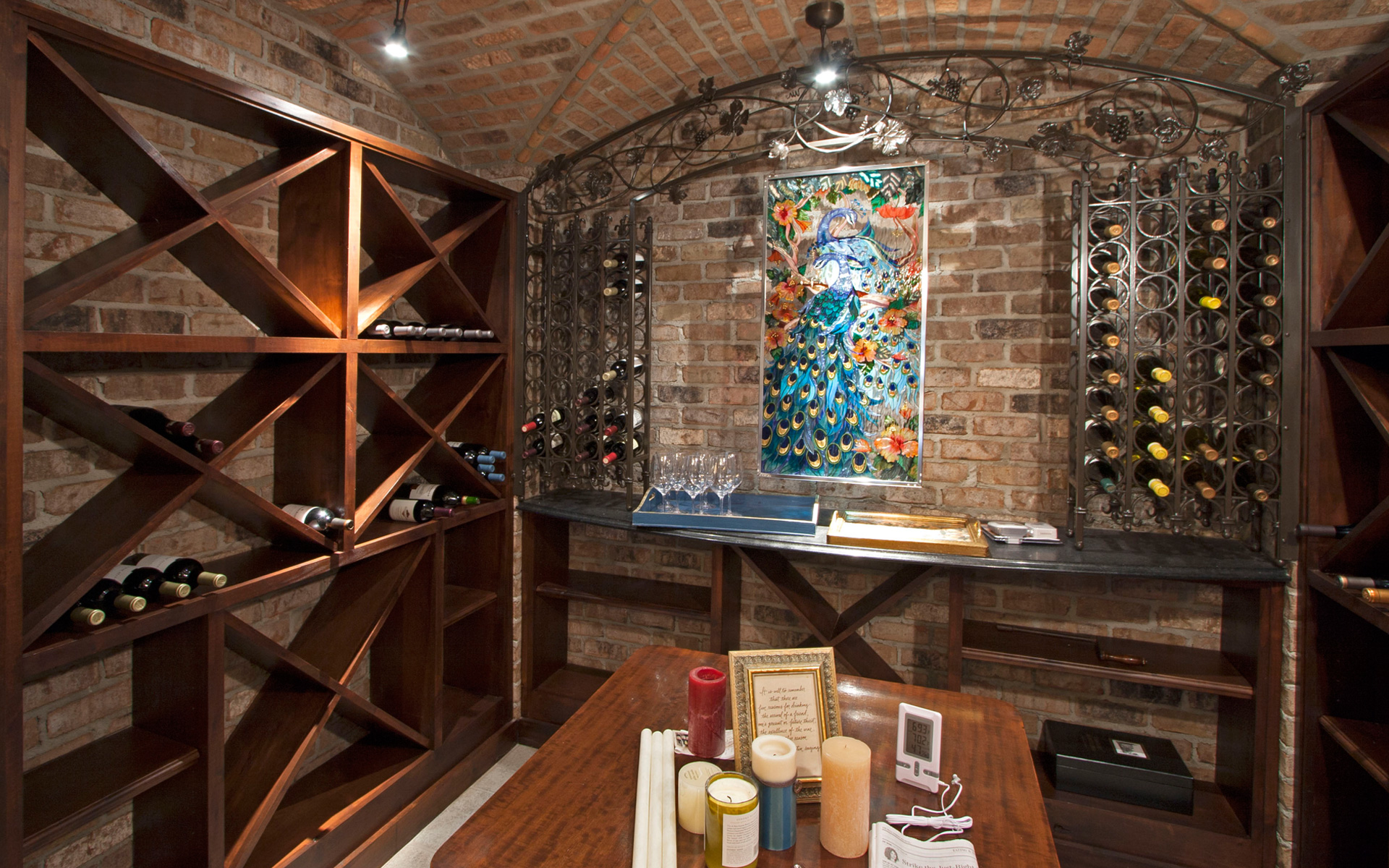
Individual Bottle Slots are the foundation of most cellar designs. Each bottle sits in its own horizontal cradle, allowing easy identification and access. We build individual slots to accommodate standard 750ml Bordeaux bottles, larger Burgundy bottles, and magnums.
Display Rows position bottles horizontally with labels facing forward. These rows are typically placed at eye level and reserved for your finest bottles — the ones you want to showcase to guests.
Diamond Bins are the classic bulk storage solution. X-shaped dividers create diamond-shaped compartments that hold 10-20 bottles each. They are ideal for cases of everyday wine that you pull from regularly.
Case Storage provides open compartments for full cases, allowing you to store new arrivals before they are ready to be racked individually.
Magnum and Large-Format Storage accommodates oversized bottles that do not fit in standard racking. We build these compartments into the lower sections of the cellar where the heavier bottles are easier to handle.
Design Principles
When designing a racking layout, we follow several principles developed over decades of cellar construction:
- Maximize capacity without sacrificing accessibility. Every bottle should be reachable without removing other bottles.
- Create visual hierarchy. Display rows and feature walls draw the eye, while bulk storage recedes into the background.
- Plan for growth. A good cellar design leaves room for your collection to expand.
- Include a tasting surface. Even small cellars benefit from a countertop or pull-out shelf for opening and examining bottles.
Step 4: Selecting the Wood
Wood selection for wine cellars requires consideration beyond aesthetics. The cellar environment — cool temperatures, elevated humidity — demands species that perform well under these conditions.
All-Heart Redwood is the traditional wine cellar wood. It naturally resists moisture, does not warp in humid conditions, and does not emit odors that could affect wine. Its warm, reddish-brown color deepens beautifully over time.
Mahogany offers similar moisture resistance with a richer, darker appearance. It is our recommendation for clients who want a more formal, luxurious aesthetic.
Cedar provides natural aromatic qualities and excellent moisture resistance. It is a popular choice for cellar interiors, though some purists prefer unscented species.
Walnut and Cherry can be used for cellar fronts, doors, and display elements, particularly in cellars that double as tasting rooms or entertainment spaces.
We discuss species options in detail during the design consultation, taking into account the cellar’s humidity levels, aesthetic goals, and budget.
Step 5: Architectural Details That Elevate the Space
The difference between a wine storage room and a wine cellar lies in the details:
- Archways and Columns — Stone or wood arches at the cellar entrance create a sense of occasion
- Custom Doors — A solid wood door with an arched top, glass panel, or iron hardware sets the tone before you step inside
- Stone or Tile Flooring — Natural materials underfoot complete the cellar aesthetic
- Integrated Lighting — LED strip lighting and recessed fixtures illuminate the collection without generating heat
- Tasting Areas — A built-in counter with bar stools transforms the cellar into an entertaining space
What to Budget
Custom wine cellar costs in the Cincinnati area vary widely based on size, materials, and complexity. A small closet conversion with standard redwood racking represents a modest investment, while a full basement cellar with exotic wood, stone, and a glass-enclosed tasting room is a significant project.
Rather than publishing generic price ranges, we provide detailed quotes tailored to your specific project. Every cellar is different, and we want to give you accurate numbers based on your actual design.
Wine Cellars for Cincinnati Area Homes
Southwest Ohio’s wine culture continues to grow. The region’s proximity to wine-producing areas in Kentucky and the Ohio Valley, combined with a sophisticated dining scene and active wine collecting community, means that custom wine cellars are an increasingly valuable home feature.
Whether you are in Indian Hill with a basement that is ready for a grand cellar, or in a Mason townhome looking to convert a closet into a compact wine room, Miami Woodworking has the experience and craftsmanship to build it.
Ready to Start Your Wine Cellar?
Visit our showroom at 3800 Taft Drive in Lebanon, Ohio to see racking samples and discuss your project, or contact us at (513) 398-8194 to schedule a free consultation. Our designers can visit your home to evaluate potential cellar locations and start developing a design that is perfect for your collection.